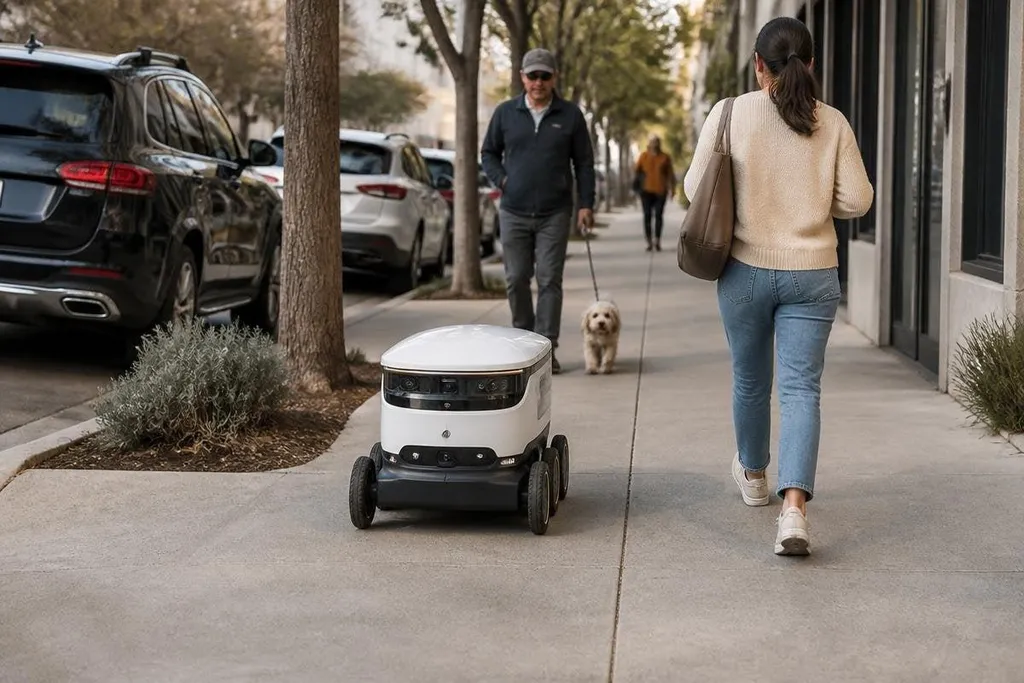
A sidewalk robot has to share space with people, bikes, parked cars, curbs, driveways, and changing weather. AI helps it interpret those details and choose a safe path, which changes the job from following a fixed route to handling a moving street scene.
Quick read:
- Cameras and LiDAR help the robot spot people, edges, and obstacles.
- AI can help with route choices when a path is blocked.
- Remote operators still matter when the robot meets a situation it cannot judge.
From fixed routes to local decisions
Older autonomous systems can follow mapped paths and stop when something blocks them. That works on a quiet walkway, but a delivery robot still needs to decide whether it can pass a person, wait beside a curb, or take another route.
AI models process camera images, LiDAR scans, wheel movement, and map data together. LiDAR measures nearby objects with pulses of light, while cameras add visual detail such as signs, surface markings, and the direction a person is facing.
From that data, the robot builds a working view of its surroundings. This view does not need to describe every object in human language. It needs to answer practical questions: where is the drivable surface, which space is open, and which movement could create a collision?
That work happens repeatedly as the robot moves. A person can step from a doorway, a bicycle can cross the robot’s path, or a delivery van can block the route. AI helps the system update its plan instead of treating the original map as fixed.
Reading human movement
Sidewalk traffic is hard because people do not move like road vehicles. A person may stop, turn around, walk toward the robot, or move aside at the last moment. It needs to estimate what may happen next while leaving enough space for the person to change direction.
This is where prediction models can help. They can use recent movement, distance, and direction to estimate possible paths. It can then slow down, stop, or pass on a wider line when the space allows it.
The decision still has limits. A model may read a child, cyclist, or person using a mobility aid differently from the patterns in its training data. Poor light, rain on a camera lens, glare, and crowded paths can also reduce the quality of its view.
For that reason, safe operation needs more than a model that labels objects. It needs speed limits, stopping rules, sensor checks, and a way to hand difficult cases to a remote operator.
Remote help remains part of the system
A remote operator can review a live situation when the robot cannot pick a route with enough confidence. The operator may select a path around a barrier or confirm that the robot should wait.
AI can sort routine cases from unusual ones, so human attention goes to the moments that need judgment. That division can reduce delays, though the result depends on the network connection, the operator’s view, and the rules that decide when help is needed.
A dated sidewalk robot trial also needs the route, weather, and point where a person took over. Robot24.com robotics coverage can place those details beside the robot’s result, giving the failure record in the next paragraph something concrete to measure.
A remote operator also creates a record of failure cases. Engineers can review blocked routes, missed objects, and repeated stops, then use those cases to improve maps, safety rules, or training data.
That process needs careful checks because a system that works well on one route may behave differently on another.
What AI still cannot solve
AI does not remove the physical limits of a sidewalk robot. Small wheels can struggle with broken pavement, steep curb cuts, loose gravel, or a gap between the path and the road. A better model cannot give the robot more ground clearance or grip.
Clear operating rules matter too. The robot must know where it may travel, how it should react near crossings, and when it must stop. Local rules and site design can matter as much as the software.
I'd choose a robot with slower, predictable behavior over one that makes fast decisions I can't inspect. For deliveries, a short wait is easier to manage than a route choice that surprises people nearby.
A practical buying and deployment check
Before placing sidewalk robots on a route, check these points:
- Map the route: record curb cuts, narrow sections, crossings, construction zones, and places where people gather.
- Test the sensors: check camera and LiDAR performance in shade, direct sun, rain, and low light.
- Set stop rules: define when the robot waits, turns back, or asks a remote operator for help.
- Measure handoffs: record how often people take control and how long each case lasts.
- Review failures: save route and sensor data so repeated problems can be fixed rather than guessed at.
The next useful test is simple: run the same route across different times, weather, and crowd levels, then compare stops, remote handoffs, and completed trips. Until those records show steady behavior outside a quiet demonstration, AI remains a support for sidewalk robots rather than a substitute for careful route design.